The island has a very mild Mediterranean climate. Average temperatures are rather high: the average annual temperature is 16.8°C, in the coldest month of January it is 9.1°C, in the hottest month of July 26.9°C. Daily and annual temperature differences are small, which is very favourable for agriculture and tourism. There are many hours of sunlight, 2,700.
Bura wind
There is little rain, about 41 days during the year, mostly in autumn and winter, while late spring is usually a dry period interspersed with rare short-lasting storms. Snow is uncommon, when it does fall it falls first in Pupnat and the surrounding peaks but thaws quickly because the temperature rarely drops below 0°C.
It is almost always windy in the Peljesac Channel. During the summer the refreshing western maestral usually blows, good for sailing; in winter the south-easterly jugo, the cold northeasterly bura, or strong northerly tramuntana.
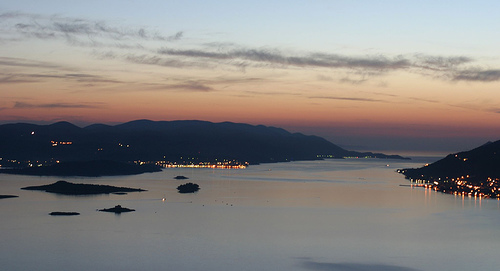
Peljesac channel at night
Sea currents in the Peljesac Channel are rather weak, growing stronger only with the jugo. The average temperature of the sea surface in March is 12.9°C. It is the warmest in summer, in July, August and September, when it averages 22.3°C. Changes of the tide are small, the difference between high and low tide is about 50 cm.