Although the islanders' way of life and work changed considerably and thoroughly through time, especially in the second half of the 20 century, many old customs connected to church holidays and other community and family events have been preserved.
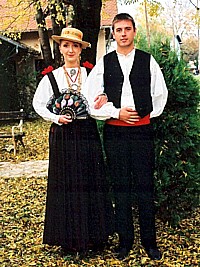
Until recently most of the people lived in villages. Their clothes were similar because they wore national costumes that changed negligibly throughout the centuries. Everyday wear was simple and dark-coloured, and for holidays they dressed in finer clothes of a richer cut and decoration.
These costumes have been preserved in most of the island villages and are used by folklore societies which cultivate folk traditions, songs and dances.
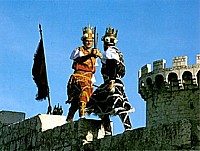
Moreska on city walls
In all the island towns carnival celebrations are customary (in the period from mid-January to Ash-Wednesday which, according to the church calendar, falls on a different date every year, by the end of February to the latest). In this period masked balls, maskare, are held every week in Korcula.
Besides individual masks, there are also funny groups with little shows, and masked performances for children. Festivities reach a peak on Shrove Tuesday, when Krnoval is placed on trial because he is to blame for all the misfortunes that happened in the town during the past year. It all ends in his punishment - he is burnt and the people celebrate with traditional local food and drinks.
Traditional outfit
Dalmatian folk songs are a special kind of folk art. Like in days of old, they are usually sung by klape, harmony-singing groups of six to nine men who meet in the evening somewhere in the town, on the seashore, and sing for their own pleasure.
Today most customs live on the island as a part of local life. They are also preserved and cultivated by culture and performing societies which exist in all the villages and give performances several times a year, usually in summer, not only in their own village but also in other places, for the numerous tourists.
Moreska
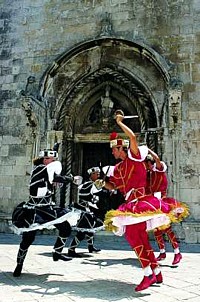
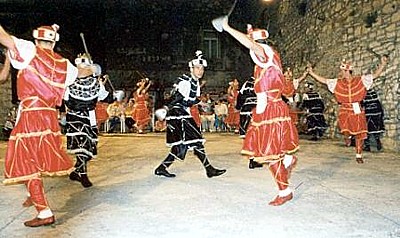
The Moreska sword dance was first mentioned in Koriula in the 17th' 18th centuries. This is not authentic local folklore but was introduced from other Mediterranean countries and symbolizes a battle between Christians and Moslems: on Corsica, Sicily, in Spain and elsewhere.
In Korcula it may have started after the Turkish siege in 1571 and this is the only place where it has survived. The dance is performed by two groups of young men called moreskanti - The Whites are dressed in red and The Blacks in black costumes.
Night dance
They are led by Kings and fight for a girl, Bula, the White King's fiancee who was kidnapped by the black King Moro.
The introduction is an old text, a dialogue between the Kings and Bula who refuses Moro, after which the two armies collide. The Whites win, Bula is returned to the White King.
A wind orchestra accompanies the dance, which has seven figures and a quickening tempo while the clashing of the swords grows fiercer.
Kumpanija
Kumpanija
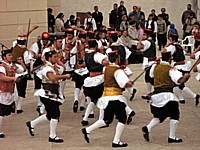
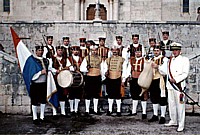
This old knightly ritual dance with long swords is mostly performed in Blato, but also in other places on the island (with slight differences): Smokvica, Cara, Pupnat. It is accompanied by dialogue, playing the misnice (bagpipe) and drums.
The dancers are men, dressed in old, rich costumes, who perform 18 intricate dance figures. It shows a fight between the enemies who are led by "Serdar" and the domestic army led by "Kapitan".
An especially picturesque moment is the unfurling of a flag up to three metres long, performed by Alfir while dancing. At the end the girls wearing old costumes join in, and dance the tanac with the Kumpanjoli.
Kumpanija outfit
Mostra
In Zrnovo (a hamlet of Postrana) a similar old battle dance with swords is performed, accompanied by misnice and a drum. The dancers wear ceremonious old island costumes. The Mostra used to end in "beheading the ox", today some other old village customs are performed with it.