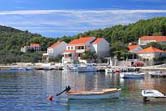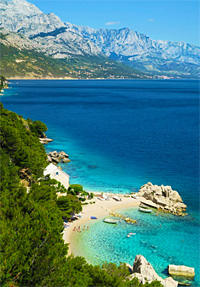
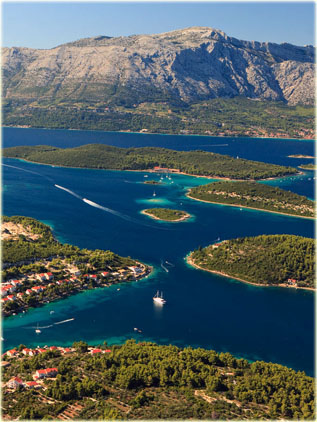
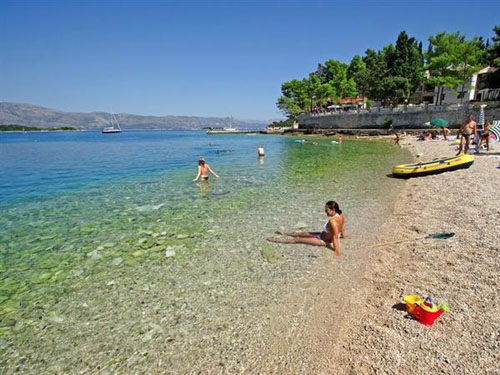
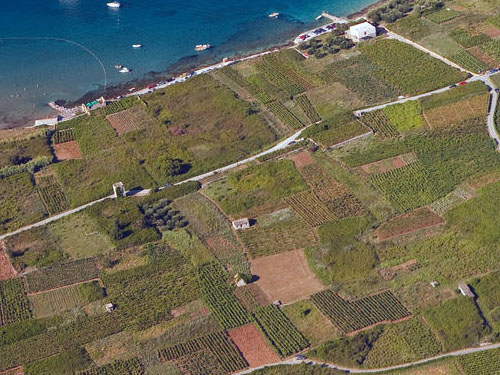
Lumbarda is a municipality with just over 1,000 inhabitants, located six kilometres east from the city of Korcula. Lumbarda is located on the eastern part of the Croatian island of Korcula, in a large bay protected from southern winds, overlooking the peninsula Peljesac and archipelago of small islands and islets spread in front of the village of Lumbarda. Lumbarda extends for several kilometres around a small bay and on the hills behind it, and is surrounded by large vineyards of sandy soil that are well know for high quality grapes. Lumbarda is reached along a good asphalt road that passes through a picturesque area of pine woods and olive groves.
For centuries the people of Lumbarda were farmers, mostly grape growers, fishermen and stone-masons. Several prominent modern Croatian artists, sculptors and painters were born here: Ivo Lozica (1910-1943), Lujo Lozica (1934), Stipe Nobilo (1945), and the most important of all, Frano Krsinic (1897-1981). He made the bronze Second World War Memorial in the centre of the village and the bronze relief Fishermen on the hotel. Nearby is the studio-house and collection of the local amateur sculptor, the peasant Ivan Jurjev-Knez (1920), who works in stone and wood.
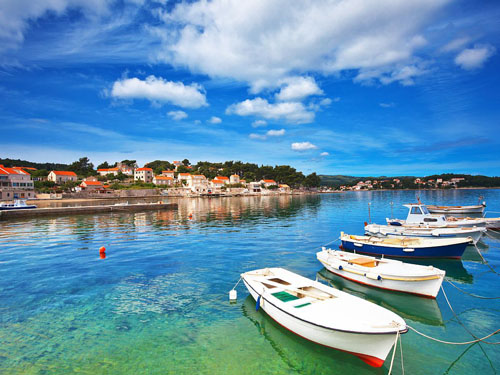
It is also important to mention the traditional shipbuilders of Lumbarda, who were among the most famous on the southern Adriatic. The green island of Korcula provided excellent building materials for their traditional wooden ships, which were very important for the everyday life of the Dalmatian, traders peasants and fishermen. It is hard to think of the more important thing for the average inhabitant of a Dalmatian island than a ship or smaller boat. Today, not many of these traditional shipbuilders remain, mainly because wooden ships are expensive to build and maintain, but on the sea, no modern ship is a match for their maritime characteristics. The traditional wooden shipbuilding is very important part of Dalmatian and Croatian cultural heritage, and one can still see many of these traditional ships and boats, carefully kept and well maintained by their proud owners. Every year, in Lumbarda "Kids boatbuilding workshop" and "Days of shipbuilding in Korcula" take place, two important manifestations that preserve this very important part of the culture and heritage of Lumbarda, the island of Korcula and Croatia.
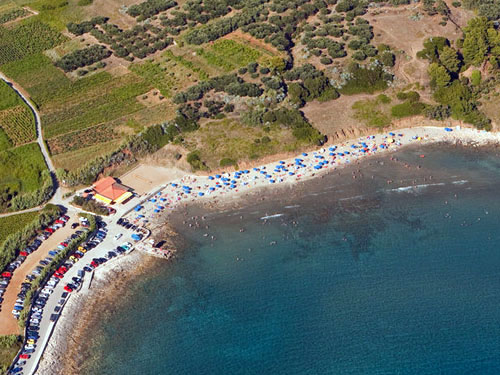
Today the local people are also engaged in tourism: there are hotels, several camps, many private pensions, restaurants, shops, and a small marina. The Ivo Lozica cultural and performing society in Lumbarda cultivates music, singing, folk dancing and amateur dramatics.
Some useful links: Wikipedia page on Lumbarda, The history of Lumbarda, Photo gallery of Lumbarda
The municipality of Lumbarda is located on the on the northern coast of easternmost tip of the island of Korcula in Croatia. The settlement developed along the coast and two well protected bays, which are well shielded from almost all local winds, except from those of the north direction, mainly "bura", a northeastern wind that blows across the narrow channel that separates the island of Korcula from the peninsula of Peljesac. The area of Lumbarda is also partially shielded from northern winds by an archipelago of small islands and islets named "Skoji" which are located in this narrow channel. Such favourable position of this region is the main reason why some of the first settlements on the island of Korcula were established in the area of Lumbarda. Lumbarda overlooks the peninsula of Peljesac and the biggest settlement on the peninsula, Orebic.

Thanks to its position, the village of Lumbarda is closest settlement to islands of Mljet and Lastovo on the island of Korcula, and for this reason most excursions and daily trips to these islands take off from the port of Lumbarda. The archipelago of the island of Lastovo, today a nature park, is located south from the island of Korcula, across the Lastovo channel, and the island of Mljet, a national park, is located to the east from Lumbarda. These two islands are very popular destinations for those that seek unspoiled natural environment, lush marine life and vegetation and are maybe the best options for daily excursions for the visitors of Lumbarda and the entire island of Korcula.
The entire are of Lumbarda is located on sandy terrain, both land and the sea bed. The sea in front of Lumbarda is shallow, and since the are is well protected it is a popular anchor place for many boats, of all sizes. There is one large port in the village of Lumbarda and also one smaller, and several anchorages. Lumbarda is located just few kilometres to the east from the town of Korcula, the main traffic, economic and cultural hub on the island, to which it is connected by regular bus lines. New, modern ferry port ("Domince") through which the island of Korcula is connected to the Peljesac peninsula and the mainland is located between town of Korcula and Lumbarda, which makes the position of Lumbarda the most attractive on the entire island, peaceful and isolated, yet very well connected to the rest of the island and the mainland through the ferry port.