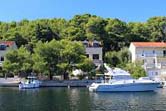
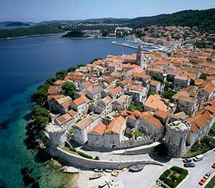
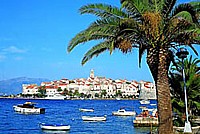
The city of Korcula lies beside the sea on the north-east end of the island Korcula. The old medieval part of the city was built on a small oval peninsula, a Baroque suburb spreads under the old city walls, and newer town quarters stretch along the shore to the east and west of the old centre. Today the city has about 3,000 inhabitants, most of them living in new parts of the city. Korcula is the seat of the administration of the Town of Korcula that includes the city, part of the island and four villages: Zrnovo, Pupnat, Cara and Racisce, with a total of about 6,000 inhabitants. Korcula has many social, cultural, economic and health institutions and organizations: a kindergarten, elementary and secondary school (grammar school), museum, library, medical centre, tourist agencies, banks, pharmacy, hotels, shipyard, shops, restaurants and so on. It also has cultural and performing societies that foster choral singing and folk dancing, and sports societies.
The 10c century Byzantine historian Emperor Constantine Porphyrogenitus was the first to mention a medieval city on the island of Korcula. He wrote about a "walled city". There are many indications that this city was located on the site of today's old part of Korcula, but no remains of Romanesque architecture from that time have been found. What remains of the old city walls, decorations, and most of all archive documents, show that a walled city existed on this site in the 13th century. It had squares and streets, churches, public buildings and houses.
This was the time when the Venetian Zorzi family ruled, and of frequent changes in administration, so the city walls and other buildings were probably often damaged. This city was much smaller than the renewed city that was built on the site at the beginning of the 15th century.
The old stone houses had only one story, rarely two, they were built of roughly dressed stone or dry-stone walls, and were unadorned. The other buildings, churches, loggias and public buildings were similar. At the beginning of the 15th century the city was completely reconstructed and none of the old town remains except the identical location of some buildings.
In the second half of the 14th century stone-carving went through a stage of rapid growth in Korcula, thanks primarily to the needs of Dubrovnik master builders for high quality stone. They came to the stone quarries of Korcula and Vrnik and with the help of local workers dressed stone to be shipped to Dubrovnik. Working alongside those excellent masters the men of Korcula learned the trade and in time became skilled enough to establish their own workshops. After that they began to receive orders for stone from Dubrovnik, and they also worked for the needs of the island. Growing more prosperous, they began to build new houses in Korcula with Gothic decorations.
In the 15th century Korcula was thus gradually almost completely transformed from a humble settlement into a city with a pronounced character and style. Public construction followed residential. A new cathedral was built first, then the other churches, town walls and so on.The 15 century was a period of great architectural nourishment when the city changed completely in a relatively short period of time.
At the beginning of the 16th century houses that had by then not been renewed got Renaissance decorations. This was a time when the city underwent real "polishing": squares and streets were paved, ornate coats-of-arms were placed on buildings, decorative columns added, but the old city nucleus retained its Gothic stamp. In the following 17th and 18th Baroque centuries building and stone-carving declined because economic conditions in Venice deteriorated, which was reflected on areas under Venetian control.
Few new Baroque houses were built, but several summer houses and houses in the suburbs show that the craft of stone carving had not died out. In this period old churches got unpretentious Baroque additions: portals, facade decorations, and in the interior marble altars imported from Italy. This was the time when the Borgo suburb was built. A Venetian provision from the 15 century expressly prohibited construction outside the city walls because enemies might use such structures during sieges. This happened in 1483 during the Aragon siege. The inhabitants of Korcula did not strictly comply with this prohibition, because the chronicler Canon Antun Rozanovic recorded that during the Turkish siege of 1571 the Turks, fleeing from a storm, pillaged and set fire to the houses in Borgo.
In the 17th century there was no more danger from the Turks so building in Borgo continued and the suburb was enlarged. Soon it became the centre of urban life and work. This was where people traded, where the major craftsmen worked, and very soon other forms of social and public life moved to that part of the town. At that time the number of inhabitants in the old city nucleus decreased: old houses were not repaired, people preferred to build new houses along the seashore near their workshops. Some old houses were reconstructed, but without attention to style so Gothic decorations were removed or destroyed. In this way many valuable buildings and carvings were lost.
In the first half of the 19th century, right until the Second World War, Korcula was a small provincial town that slowly began to turn to tourism, because its earlier main crafts of stone carving and shipbuilding were pushed back by industrial production and a new way of life. Several small hotels and summer houses near the town were built at that time.
After the Second World War an industrial shipyard was founded and accommodation was needed for its workers, so new residential estates were built to the east and west of the city on the slopes above the sea, larger hotels, public buildings, a new quay, roads, a marina. In the old part of the city ruinous or damaged houses were repaired to be lived in and for public use, for example to house museums and the like.
 The 10c century Byzantine historian Emperor Constantine Porphyrogenitus was the first to mention a medieval city on the island of Korcula. He wrote about a "walled city". There are many indications that this city was located on the site of today's old part of Korcula, but no remains of Romanesque architecture from that time have been found. What remains of the old city walls, decorations, and most of all archive documents, show that a walled city existed on this site in the 13th century. It had squares and streets, churches, public buildings and houses.
  In the second half of the 14th century stone-carving went through a stage of rapid growth in Korcula, thanks primarily to the needs of Dubrovnik master builders for high quality stone. They came to the stone quarries of Korcula and Vrnik and with the help of local workers dressed stone to be shipped to Dubrovnik. Working alongside those excellent masters the men of Korcula learned the trade and in time became skilled enough to establish their own workshops. After that they began to receive orders for stone from Dubrovnik, and they also worked for the needs of the island. Growing more prosperous, they began to build new houses in Korcula with Gothic decorations.
 At the beginning of the 16th century houses that had by then not been renewed got Renaissance decorations. This was a time when the city underwent real "polishing": squares and streets were paved, ornate coats-of-arms were placed on buildings, decorative columns added, but the old city nucleus retained its Gothic stamp. In the following 17th and 18th Baroque centuries building and stone-carving declined because economic conditions in Venice deteriorated, which was reflected on areas under Venetian control.
  In the 17th century there was no more danger from the Turks so building in Borgo continued and the suburb was enlarged. Soon it became the centre of urban life and work. This was where people traded, where the major craftsmen worked, and very soon other forms of social and public life moved to that part of the town. At that time the number of inhabitants in the old city nucleus decreased: old houses were not repaired, people preferred to build new houses along the seashore near their workshops. Some old houses were reconstructed, but without attention to style so Gothic decorations were removed or destroyed. In this way many valuable buildings and carvings were lost.